Ferrosur - Beyond Tierra Blanca

Ferrosur's Linea G
-
Ferrosur's Linea G branches off of the Mexico to Veracruz mainline at Cordoba. It then runs southward, dropping into the coastal plains on its way to the gulf port of Coatzacoalcos. The line also connects with the former FC Chiapas Y Mayaba at Medias Aguas and Coatzacoalcos. The yard at Tierra Blanca, located about 80 KM south of Cordoba, is the hub of operations for the western part of this line. Linea G serves the many oil refineries along the gulf coast, as well as cement plants, sugar processing plants and the large Modelo brewery at Tuxtepec Oaxaca.

At dusk, an SF30C clears into the north end of the Patio Norte at Tierra Blanca. The town is quiet except for the distant sounds of boxcars being switched, music playing in nearby houses and children playing baseball in the street.


The quiet is broken by a southbound unit cement train slowly passing through yard limits, blasting the whistle over the many residential street crossings on the north side of town. The yard job has cleared out to let the road train by.


As the cement train pulls through town, baseball and quiet returns to the neighborhood streets.
The yard job is tying up at the depot at the end of their day.


A southbound manifest train is slowly passing through Tierra Blanca while entering the Patio Sur. Migrants patiently waiting for a northbound train are very common around the yard here.


Having just returned from switching at Tuxtepec, Oaxaca, a former AT&SF SF30C pauses at the South Yard at Tierra Blanca.

Earlier in the day, a yard job is switching the small yard at Papaloapan. They have pulled off the branch from Tuxtepec, and will pick up a few cars from the small yard before returning to Tierra Blanca. The SF30C is one of two that remain on the Ferrosur roster. Made from U36C's, the Santa Fe custom made the unique cabs and noses on 70 such locomotives. Several were eventually sold to FNM. However, only two remain in Mexico, both on Ferrosur's roster. Number 9530 is preumably still wearing the same number used while on the Santa Fe.


A northbound quimico (tank cars from the Coatzacoalcos refineries) at Granja.

At Tres Valles, Veracruz, I wanted to photograph the northbound quimico as it crested this short grade. But just as the train got close, my autofocus picked up on this guy walking across the tracks. Walking back to town from the sugarcane fields with his blade across his shoulder, I immediately thought he was more interesting than the train.


At Medias Aguas, a single Ferrosur engine rests on the south leg of the wye. This is the junction with the former FC Chiapas y Mayaba line to Salina Cruz and the Guatamala border. Although information is scarce, FIT is reportedly operating this line as far as Salina Cruz. However, there were several Ferrosur boxcars parked on the main track south of the wye with no indication of recent movement. The rails were rusted over, and dirt filled in the flangeways at all the crossings.

Ferrosur - Distrito Acultzingo

Beginning its run over Ferrosur's Linea SC, this empty grain train from Tehuacán, Puebla curves under Pico de Orizaba. The train entered the main track from Linea VB at Cañada Morelos, and is climbing the last grade before beginning the long descent to Orizaba.
-
For a map of Distrito Acultzingo and Lineas S/SC, click here:
-
Crossing Puente Vaqueria, a northbound train is climbing out of the Valle del Rio Blanco. The tracks in the foreground were passed over approximately 10 minutes earlier.


At Vaqueria siding, a southbound empty grain train is taking the siding to meet a northbound loaded train.


A southbound manifest train is passing over the north switch of Vaqueria siding.


At Vaqueria, a northbound grain train is slowly grinding up the grade. If you look closely, the tracks below are visible at three different level. A short following train can be seen on the loop above the town of Acultzingo.


The top of Pico de Orizaba is barely visible through the haze above this southbound train winding down the grade below Vaqueria.


In the afternoon, a southbound train is approaching the small village of Vaqueria.


As viewed from Vaqueria siding, three trains are visible in this picture; a grain train in the foreground, and two trains meeting at Huixtlitla in the valley below.


A northbound unit grain train is winding around the village of Vaqueria as it leaves Huixlitla siding.


The same train is seen at Huixlitla. Notice that the north end of the siding is currently being extended.


Looking down at Huixlitla, the tracks ahead can be seen above this train.


Above the town of Acultzingo, a Mexico to Veracruz intermodal train is exiting a tunnel as it winds down the grade.


Marigold flowers cover many farmers' fields in October and November. Being the flower used to commemorate dead relatives on Dia de los Muertos, orange covered plots scatter the valley all throughout Mexico. A week after the holiday, a stand of marigolds remain in this field above the town of Acultzingo as a southbound exits a tunnel.


The town of Acultzingo is a quiet village that lays off the old highway through the region. Many times a day, the chatter of roosters, mules, goats, cows and distant banda music is broken by the howling of dynamic brakes or the thunder of uphill trains in run 8. The sounds of one train can be heard for nearly 30 minutes as it winds through the hill above the town. The main street through the village was quiet until a local delivery truck pulled up to a store moments before a southbound train entered town.


A MOW crew prepares to begin working as a southbound enters the town of Acultzingo. The tracks above the loop at Acultzingo are visible above the train.


A guard checks off the passing trains at the Acultzingo station.


Below Acultzingo, the line passes through a chain of tunnels and another loop at Mezquite. This southbound unit cement train is exiting Tunnel Nuevó Leon and about to enter another before entering the loop. Notice the tracks below. Above the locomotives in the distance, a northbound intermodal train is passing through the loop at Acultzingo.


The same train on the lower portion of the Mezquite loop.


After reaching the summit of Distrito Acultzingo, northbound trains set-out their DPU's at Jesus de Nazareno. An extra crew will then gather all the units and run light back down the hill. Here, a light engine consist is passing through the loop as Mezquite as a local walks through with his burro.


A long cement train descents through the loop at Mezquite.


A northbound VIP train climbing through the valley between Tecamalucan and Mezquite.


At Tecamalucan, a southbound is exiting tunnel San Luis Potosi. If you haven't noticed, the tunnels here are named after the states of Mexico.


At Encinar, Distrito Acultzingo (Linea SC) diverges from the original Linea S. The original line climbed up through a different valley, encountering 4.7% grades and very sharp curves. Distrito Acultzingo was built in the 1980's to bypass this line. A former FC Mexicano/NdeM GE box cab is put on display here as a monument to the new line. The last rail of the old line is still poking out of the dirt.


Moments away from a crew change in Orizaba, the whistle is howling as this southbound quickly rolls through Ciudad Mendoza's centro at dusk.


A morning view of Orizaba Yard. While not at the bottom of the grade, this is the base for operations throughout Ferrosur's southern end.
For more information and pictures from Distrito Acultzingo, click here:

Ferrosur - South of Mexico City

Ferrosur's mainline from Mexico City climbs out of the Valle de Mexico eastward into the high plateaus and valleys of Tlaxcala and Puebla states. Along the foot of La Malinche, the line reaches its highest elevation at the Huamantla Summit - 8,235'. These high valleys are surrounded by many volcanic peaks of the Sierra Madre Orientals.
-
One of my first impressions from this years visit to Ferrosur Teritory was the amount of Ferromex AC44CW's that Ferrosur has reportedly purchased. They are still painted in Ferromex colors, but relettered for Ferrosur. I'd imagine that Ferrosur's AC44CW fleet has almost doubled with the addition of the Ferromex units. But aptly so, because their mainline was about the busiest that I have ever seen it over the time that I was there.
For a map of Linea S, click here:
The Mexico City radio stations are beginning to fade away as I drive behind Popocatépetl and Ixtaccíhuatl. Mexico City lies immediately on the other side of the two peaks. The Ferrosur mainline passes to the north of them as they climb out of the Valle de Mexico into the high plateaus and valleys of Tlaxcala and Puebla States.

Near Soltepec, a southbound manifest train moves along at track speed.

A southbound manifest train slowly climbs the steep grade approaching Muñoz siding. The train will take the siding here to meet an approaching northbound.


The same southbound train pulling into the siding at Muñoz.


The southbound manifest train had a surprise on the rear, a Ferrosur passenger car.


Here is a view of Huamantla Summit. Along the foot of La Malinche, this crest 8,235' crest is the highest point on Linea S between Mexico City and Veracruz. Notice the peak of Pico de Orizaba visible on the horizon to the right.


Between San Marcos and Jesus de Nazareno, Linea S encounters a short but steep hill. This southbound train was moving at near the track speed of 70 KPH, but was quickly down to a crawl as it started up the short grade.


Near the summit of this short grade, there is an abundance of pine trees. Here, a southbound vehicle train with a single locomotive is struggling up the grade, approaching the summit. The engineer momentarily turned off the headlight as he approached my location.


In the shadow of Pico de Orizaba, the same southbound vehicle train is beginning the short descent toward Jesus de Nazareno.


South of Jesus de Nazareno, Ferrosur trains enter Linea SC, also known as FNM's Distrito Acultzingo. This is the line relocation that take Ferrosur's mainline down the face of the Sierra Madre Orriental to Orizaba. This southbound vehicle train is beginning the trip across Linea SC at San Antonio Soledad. The west slope of Pico de Orizaba is visible to the right of the train.

Ferromex - Distrito Huichapán

Of course I found time to spend a couple of mornings watching trains on Ferromex's Distrito Huichipan between Queretaro and Mexico City. For more information on this mountainous mainline, follow this link;


Above Tequisquipan, a southbound vehicle train is down to a crawl as it climbs the steep grade toward the Quretaro-Hidalgo state line. Turning southward, this short canyon leads to one of two summits between Queretaro and Mexico City.


A southbound Metalero from Alzada, Colima to Puebla is approaching the tunnel at the summit of the grade, passing underneath the Queretaro-Hidalgo state line. Notice how the tracks dip through the tunnel, a result of a project to lower the tracks in order to allow clearance for double-stacked containers.


The same metalero exiting the tunnel.


At the bottom of the Huchipan Valley, a northbound manifest train crosses over Barranca de los Muertos.


Splitting a pair of intermediate signals, a southbound vehicle train is climbing the grade above Huichiapan. This is part of a 180 degree loop around the town of San Jose Atan.


Between Huichipan and Nopala, the tracks pass through a series of loops in order to gain elevation while climbing out of the Huichipan Valley. Here, the southbound metalero is seen negotiating the first curve.


The mid-train DPU is seen passing through the first curve.


Above the loops, a southbound manifest is slowly grinding up the grade toward Nopala. I was pleasantly surprised to find consists of Super 7's once again running into Mexico City. For a couple of years, AC44CW's and ES44AC's have been the regular locomotives in this region.


The southbound metalero approaching the highway crossing near Nopala.


At Escandon, the metalero is transitioning into dynamic braking as it begins the final descent into Valle de Mexico and Mexico city.


The train is quickly gaining speed as the DPU approaches in full dynamic braking.


Also at Escandon, the same vehicle train is rolling fast as it begins the long descent.


Arch Bridges of Michoacan

While traveling along the coast of Michoacan in search of surf, I decided to follow Kansas City Southern of Mexico's (KCSM) line inland from the Port of Lazaro Cardenas. Of all the lines in Mexico, I am the least familiar with this line. In the 1970's, the original NdeM line to Uruapan (as well as the the branch to Apatzingan) was extended through the deep and desolate canyons of the Rio Balsas to reach the deep Pacific port. Since then, the port has grown in importance, gaining a respectable position in the west coast maritime shipping industry. Of course, the KCSM line has also seen an increase in importance as containers and other freight is shipped inland.
-
One of the locations that have always fascinated me is the large steel arch bridge that is on this line near Nueva Italia. At the time, I had only seen two pictures (one in Matt Herson's book) of the bridge, and had a vague idea of where it was located. Since I only had one day to spare, I decided to drive inland with the hope of locating it. After a while wandering back roads near El Marques, I finally pin-pointed the ravine, and eventually made my way to the bridge. Unfortunately, in the next 6 hours of waiting, there was very little action to be found.

After waiting for about 1 hour, I finally heard the dispatcher issuing track warrants to a southbound train that was approaching. About 45 minutes later, I was disappointed to find that it was only a high-rail truck inspecting the line


Later in the afternoon, I heard a local train in Nueva Italia calling the dispatcher. The had finished their work (presumably on the branch to Apatzingan) and were ready to depart north. After being excited about the approaching train, I was again disappointed to find that it was only a single engine returning to the yard in Uruapan. Here is is seen crossing the bridge.


While returning to the autopista, I was surprised to find a second such arch bridge located about 20KM to the north. Unfortunately, this ravine was covered with tall heavy brush, limiting the photographic opportunities.

Mexico's Last Alco - A Side Trip to Alzada

On this trip through Mexico, I decided to make a sidetrip to Alzada, Colima. Hylsamex runs an ore pelleting plant here in the coastal mountains of Colima state. Raw ore that is delivered by Ferromex is processed into pellets, then shipped in unit trains to steel plants around Mexico. The real attraction is a well-kept Alco RS-2 that has been used as the plant switcher for many years.
After driving around the perimiter of the plant, I finally located the RS-2 at Hylsamex's smalll engine facility. Unfortunately the unit was down for some shop work. The good news is that it looks like some heavy maintainence is being performed in order to keep the historic unit running.
Referencing these pictures, a well-versed former Alco mechanic in California said "it looks like they are going to replace some cylinder heads,under the plastic in the foreground, valve covers with rocker arms on the running board to the left of the mechanics. The old girl may get a chance to continue working."
Now just lettered "Hylsa," number 801 is sitting in the small engine shop on Hylsamex's property at Alzada.


While the RS-2 was not running on this visit, the other plant switcher was busy shuffling loaded gondolas between the Ferromex transfer and the plant. Here, the GE engine is seen shoving one last gondola of raw ore into the rotary dumper.


After unloading raw ore, the plant switcher is seen shoving processed ore pellets back to the Ferromex transfer yard.


The small yard along the Ferromex mainline originates some of the "metalero's" that can be seen shipping ore to steel plants around Mexico. Raw ore is delivered to the plant for proccessing. Ferromex then picks up the processed ore pellets inunit trains.


After dropping off the pellets, the switcher then pulls a cut of raw ore back into the plant.


A trainman rides the end of the cut back to the rotary dumper.

At near by Atenquique, the Atenquique Paper Company has a large plant that sits in the bottom of a deep ravine. The plant has a small but impressive rail line that crosses two rivers to connect to the Ferromex mainline. Although it seems that rail operations are rare (or suspended) the plant's Porter switch engine sits at the entrance.

The ChP survives at Empalme

While visiting Ferromex's Emplame Yard and invited into the engine servicing tracks, I stumbled upon this surprising locomotive. Ferromex 3024 is a GP38-2, still wearing the FNM two-tone blue paint scheme. It was immediately obvious that the peeling FNM paint revealed the venerable green and red of the NdeM paint scheme. However, the real surprise came when the foreman showed me the other side of the locomotive. The FC Chihuahua al Pacifico lettering was almost completely uncovered, as well as the Chepe logo. And, it was all in perfect condition - as if untouched since the ChP became part of NdeM.


Benjamin Hill - Around the Shops

Benjamin Hill
-
Although I did not see any mainline action in northern Sonora, I did have a chance to take a self guided tour of the former SBC General Shops at Benjamin Hill. Most of the equipment was left outside in a derelict and rusted condition. However, some pieces were in better shape than they look - in my opinion.

Of course, the highlight of the tour was the discovery of SBC 2203-B, an EMD FT B unit. This locomotive was former Northern Pacific, coming to SBC with 2203 - the A unit. While 2203 is in the Puebla Museum, the last remaining FT B unit rusts away in the yard.


Scribed I97 - presumably meaning Inventoried in 1997, after the privatization of FNM.


The distinctive FT windows, flanked by rust.


A look inside at the end of the prime mover and turbo.


Former SBC passenger cars Mexicali Rose and Maria Elena were also found in the yard. Both of these cars were frequently used on the Southwest Railroad Museum's trips to Puerto Peñasco.


A look at the interior of the Maria Elena reveals that the car has been vandalized. However, most of the hardware and equipment was still in good condition and could easily be repaired. The friction bearing trucks are a different story though.


Cabooses in the yard are still lettered for FNM's Region Pacifico.


A former FC Pacifico weed spraying box car.

A variety of cabooses left in the yard. Notice the passenger tucks.

Railbiking the Carrizo Gorge

I recently took railbike trip on the former San Diego and Arizona Eastern Railroad into the Carrizo Gorge. The line is currently embargoed east of Jacumba because of bridge conditions, so this gave me the perfect opportunity to ride the line. This trip was in late January, 2009.
A look at how the railbike works; a front wheel is guided along the rail by flanges and a powerful magnet. This keeps the front wheel of the bike on the rails. An outrigger hold wheels against the opposite rail and holds the bike vertical. Then the rear wheel follows the front wheel, tracking independently on the rail.

Here's the front wheel.


At speed, you can see how the front wheel tracks on the rail.
__________________________________________


Heading Into the Gorge
-
Starting the trip in Jacumba, the valley is pretty wide and flat. The line turns northward, away from the Mexican border and begins the descent along Carrizo Creek.


The first crossing of Carrizo Creek. You can see that some work has recently been done on this trestle.


The first tunnel, leading into the upper reaches of the gorge.

Entering the gorge.


Immediately, the gorge deepens and the rails wind along the steep edges. Many bridges are engineered to hold the tracks against the canyon walls.


Exiting Tunnel 8.

At Titus siding, three ex-Montreal commuter coaches and a caboose are stored in the siding. Its a long story why they're there, but now they are stuck in the gorge because of the embargo.


Inside Tunnel 10, the longest in the gorge.


The impressive Goat Canyon Trestle carries the tracks across a crumbling slope of the canyon. Originally, the line passed through a tunnel here. But after sliding away several times, the bridge was built as a permanent bypass.


Presumably, this tunnel just east of the trestle was one that had collapsed. In order to reopen this line after many years of abandonment, many of the tunnels needed to be cleared and repaired. This tunnel is where I turned around to head back to Jacumba.


Back at the trestle, the semaphore blade is still attached to the signal that protected train movements over the bridge.


It is obvious that some work has been done to the deck of the Goat Canyon Trestle.

Stone retaining walls hold the tracks against the canyon walls.


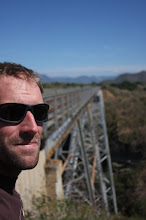
A self portrait at speed. The lantern is definitely needed inside the longer tunnels.

Entering Tunnel 10 again.


On the return, I derailed and shredded the side-wall of my front tire at MP 97 - still 5 miles from Jacumba.

So I pushed the bike the rest of the way.


At the west end of the gorge, the SD&AE "no trespassing" sign still stands, although heavily worn.